

Socceroos vs Colombia : Australia’s friendly against Colombia in Bogotá quickly became a challenging encounter. Colombia dominated from the outset, using high pressing and quick ball circulation to control the game. The early penalty awarded to the hosts added pressure and disrupted Australia’s initial rhythm, leaving the Socceroos chasing the match from the start.
Even with Jackson Irvine returning from injury, the Socceroos struggled to connect their midfield with forward players. Only two shots were registered, with just one on target, highlighting their inability to create sustained attacking opportunities. This result exposed gaps in both defensive structure and attacking cohesion that Popovic must address in preparation for upcoming international fixtures.
Controversial Penalty and Match Statistics : Early Momentum Shift – Socceroos vs Colombia
The key moment of the match came in the opening stages when a penalty was awarded for minimal contact inside the box. Popovic described it as “soft” and expressed frustration at the speed of the decision and the lack of VAR review. James Rodríguez converted the spot-kick, giving Colombia a 1–0 lead and immediate control.
Statistical analysis underscores the one-sided nature of the match:
Match Stats Snapshot
| Metric | Colombia | Australia |
|---|---|---|
| Goals | 3 | 0 |
| Shots | 16 | 2 |
| Shots on Target | 8 | 1 |
| Possession | 65% | 35% |
| Passes | 705 | 381 |
| Pass Accuracy | 91% | 83% |
| Fouls | 16 | 2 |
| Yellow Cards | 1 | 2 |
Key insights from the match include:
• Colombia dominated possession, limiting Australia’s ability to build attacks.
• The early penalty disrupted the Socceroos’ strategy, allowing Colombia to press with confidence.
• Luis Díaz and James Rodríguez consistently found space behind Australia’s defensive line, creating repeated scoring opportunities.
The table and stats highlight that Colombia’s control extended beyond the penalty and dictated the flow of the entire match.
Colombia’s Tactical Control : Breaking Down Australia – Socceroos vs Colombia

Colombia’s approach combined high pressing with smart transitions, keeping Australia under constant pressure. Midfielders Rodríguez and Uribe dictated the tempo, closed down spaces quickly, and recycled possession efficiently. Australia struggled to adapt, especially in connecting their midfield with forwards such as Nestory Irankunda and Mitch Duke.
Challenges for the Socceroos included:
• Limited attacking width, allowing Colombia to congest central areas
• Slow transitions that left forwards isolated
• Minimal creativity from fullbacks to support wide play
A clear example came with Colombia’s third goal. After winning the ball in midfield, Luis Díaz ran behind Australia’s defensive line and scored with a composed finish. This highlighted the difference in execution and decision-making between the teams.
Australia’s Weaknesses Exposed : Structural Issues Beyond One Game – Socceroos vs Colombia
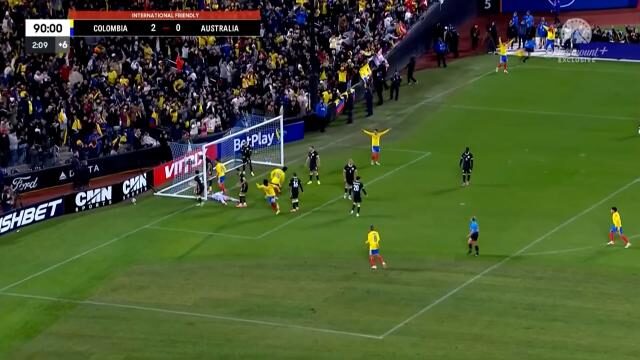
While the penalty drew attention, the match exposed systemic weaknesses. Defensive gaps were repeatedly exploited, and the midfield struggled to regain possession under pressure. Attacking movements were often predictable, making it easier for Colombia to anticipate and neutralise threats.
Additional observations:
• Loss of second balls and poor recovery speed
• Difficulty creating prolonged possession in attacking areas
• Lack of variation in attacking patterns
For instance, Colombia repeatedly bypassed Australia’s midfield, leaving forwards isolated. The inability to adjust mid-game underlines structural problems that need correction before more challenging fixtures.
Popovic’s Post-Match Reaction — Calls for Accountability and Improvement

Post-match, Tony Popovic addressed both the penalty and the overall team performance. He emphasised the importance of accountability and improvement, highlighting several key areas:
• Tightening defensive organisation and recovery
• Improving link-up play between midfield and forwards
• Increasing attacking movement and creativity
Popovic framed the defeat as an opportunity to learn. He called for immediate adjustments and stressed that players must respond decisively in future matches. The focus is on regaining cohesion and confidence ahead of upcoming international fixtures.
Conclusion — Lessons From a 3–0 Setback
The Socceroos vs Colombia friendly highlighted two intertwined narratives: the controversial early penalty and Australia’s broader structural vulnerabilities. Colombia’s 3–0 victory reflected their tactical superiority, precise execution, and control across all key phases.
For Australia, the loss serves as a wake-up call. Rebuilding defensive solidity, improving attacking creativity, and enhancing cohesion will be essential before future international challenges. Popovic’s task is clear: address the tactical gaps revealed in Bogotá and ensure the Socceroos are better prepared for the next fixture.


