

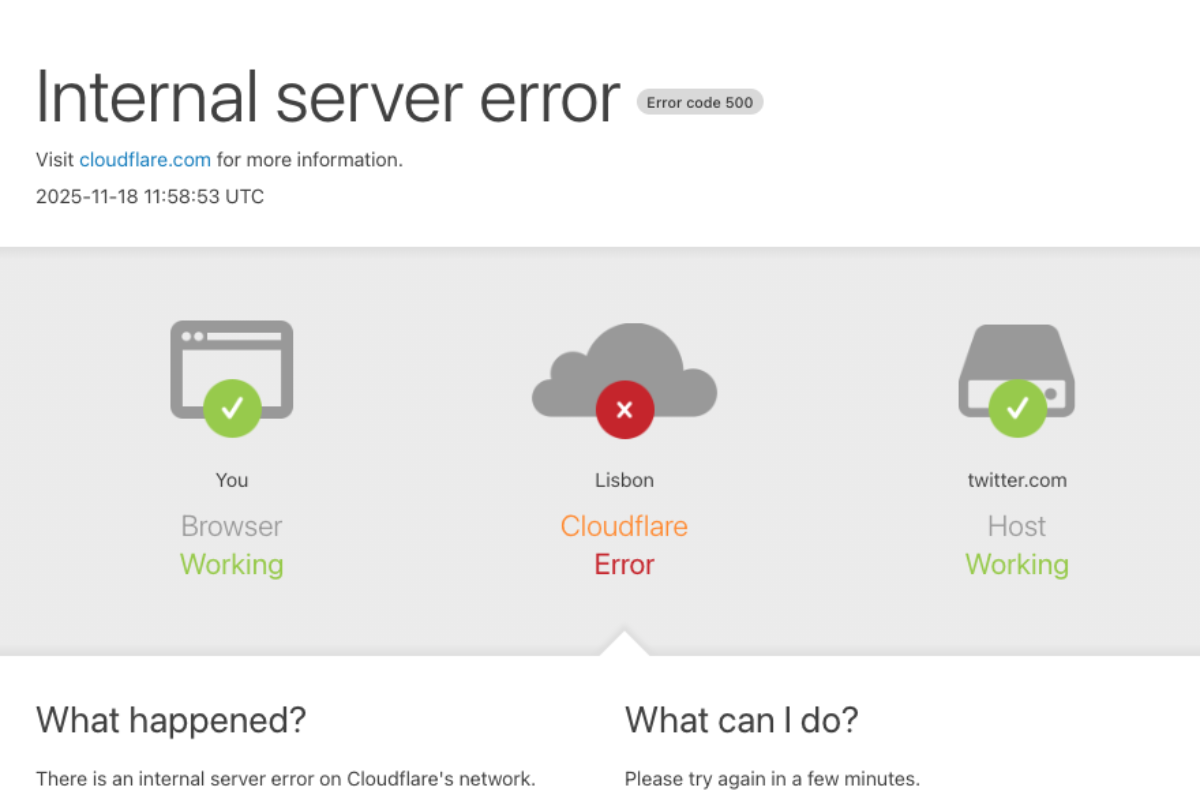
If electricity failed for three hours politicians would hold emergency briefings, if water stopped flowing there would be inspections and public apologies, and if planes were grounded the nation would demand accountability, yet when the cloud infrastructure responsible for a fifth of global internet traffic collapsed we collectively shrugged, refreshed our pages, posted memes, blamed “the internet,” and moved on — but Perth did not move on so easily, because it felt the outage in ways Sydney and Melbourne did not, and that difference matters, since the Cloudflare incident didn’t break Perth but instead exposed just how easily it could be broken.
When Cloudflare went down, essential services followed


During the outage, Perth saw disruptions including:
- Airport information and flight boards
- Online check-in
- Payment processing systems
- Government portals
- ChatGPT, X, Spotify and retail sites
- Cloud dashboards and APIs
- Contact forms and authentication systems
All of that — from air travel to AI — collapsed because one U.S. company had a routing failure.
That’s not an inconvenience.
That’s a national infrastructure vulnerability.
Australia regulates power and water. Why not the internet? -Cloudflare Outage Perth
Power is legally defined as essential, water is legally defined as essential, transport systems are legally defined as essential, and even telecommunications receive partial regulation, yet the internet infrastructure that underpins and enables every one of those sectors is not classified with the same level of importance — and that is a gap that must change.
Table: Regulated vs Unregulated Infrastructure in Australia
The outage didn’t expose a technical weakness — it exposed a legislative one.
Perth as the national red flag (Cloudflare Outage Perth)

Other cities slowed down.
Perth went dark.
Not literally — but digitally.
A single outage caused cascading failures across systems because Perth lacks:
- Local routing redundancy
- Sovereign backups
- Regional cloud nodes
- Internet infrastructure classification
- Mandatory failover requirements
Perth is the warning.
Sydney and Melbourne are simply next.
Experts say Australia is already out of time (Cloudflare Outage Perth)

Cybersecurity specialists have been warning government committees for years:
“Private cloud cannot be the sole foundation of public infrastructure.”
The Cloudflare outage was not catastrophic.
But the next one could be.
Because today, outages break streaming and flights.
Tomorrow, they may break hospitals, law enforcement or defence.
We can no longer treat the internet as optional.
What must change immediately

Australia needs:
- Internet backbone reclassification as essential critical infrastructure
- Government oversight of routing and CDN dependencies
- Mandatory reporting for infrastructure-level outages
- Regional redundancy investment (especially in WA)
- National cloud continuity standards
- Incident coordination just like energy blackouts
- Public communication protocols
We have built a 21st century country on 20th century assumptions.
That is the real outage.
Perth’s Cloudflare outage was not just another tech story but a blueprint for national infrastructure policy failure, because the internet is not entertainment, optional or a “nice-to-have” — it functions as water, electricity and transport for the digital era — and until Australia begins regulating and protecting it with that same level of urgency, every outage, even the smallest one, will continue to remind Perth and the rest of the nation just how exposed we really are.


