

ALGS Scoring System Guide – In the high-octane world of the Apex Legends Global Series (ALGS), victory isn’t just about who has the fastest trigger finger. It is a mathematical chess match played out at high refresh rates and even higher stakes. While casual players might focus on the “Champion” screen, pro teams are obsessed with a dual-priority engine: Eliminations and Placement. This delicate balance ensures that the most versatile teams—those who can both win a frantic 3v3 fight and navigate a chaotic final circle—ultimately rise to the top of the standings.
Competitive Apex is unique because it isn’t a head-to-head game; it is a 20-team ecosystem. This means a team could technically “win” the game by being the last ones standing, yet still walk away with fewer total points than the team that finished in 5th place but cleared half the lobby on their way there. This friction between aggression and caution is what creates the “Apex Meta,” where every decision to engage or retreat is weighed against the potential point yield.
The Evolution of the 2025 Season

The 2025 season proved that consistency is the only currency that matters in the Pro League. Throughout the spring and early summer, the global regions showcased vastly different playstyles. The Pro League Split 1, which ran from April 6 to June 15, 2025, featured a grueling round-robin format across four major global sectors.
Regional Standout Performers – Split 1
Americas
HUSS, Team Falcons, Shopify Rebellion
Heavy emphasis on “Edge” play and high-kill counts.
EMEA
NAVI, Team Nemesis, Alliance
Calculated rotations; NAVI’s legendary 101-point day.
APAC North
REJECT, Fnatic
Disciplined zone holding and legendary Legend diversity.
APAC South
Legends Gaming, Boogie Boarders
High-pressure late-game positioning and aggressive third-partying.
In North America, the veteran heavyweights like Team Falcons and NRG proved that aggressive firepower can often outpace pure placement strategies. Meanwhile, in the EMEA region, NAVI produced one of the most dominant single-day performances in history on April 13, racking up a staggering 101 points. This feat illustrated how a “perfect storm” of high placement and double-digit kill games can make a team look untouchable, effectively ending the conversation for that match day before the final game even began.
The Anatomy of a Match: Breaking Down the Numbers

The ALGS utilizes a weighted system to ensure that a team’s total score reflects their total contribution to the lobby. Instead of a flat reward for winning, points are tiered to keep the middle-of-the-pack teams fighting for every single position.
- Eliminations (Kill Points): Every player a squad sends back to the lobby is worth 1 point. There is no “cap” on kill points, meaning a team that goes on a rampage can potentially earn more points through combat than the match winner earns through placement.
- Placement Tiers: Points are awarded based on where a team finishes. 1st Place (the Apex Champions) receives 12 points, 2nd Place receives 9 points, and 3rd Place receives 7 points. The rewards scale down to zero once a team falls below 10th place.
- The Multi-Match Cumulative: In the Pro League, these scores are tallied across a series of six matches. This forces teams to be resilient; if you get “contested” and die off-spawn in Game 1, you have five more games to make up that 10–15 point deficit.
The “Match Point” Phenomenon: Sudden Death on the World Stage – ALGS Scoring System Guide
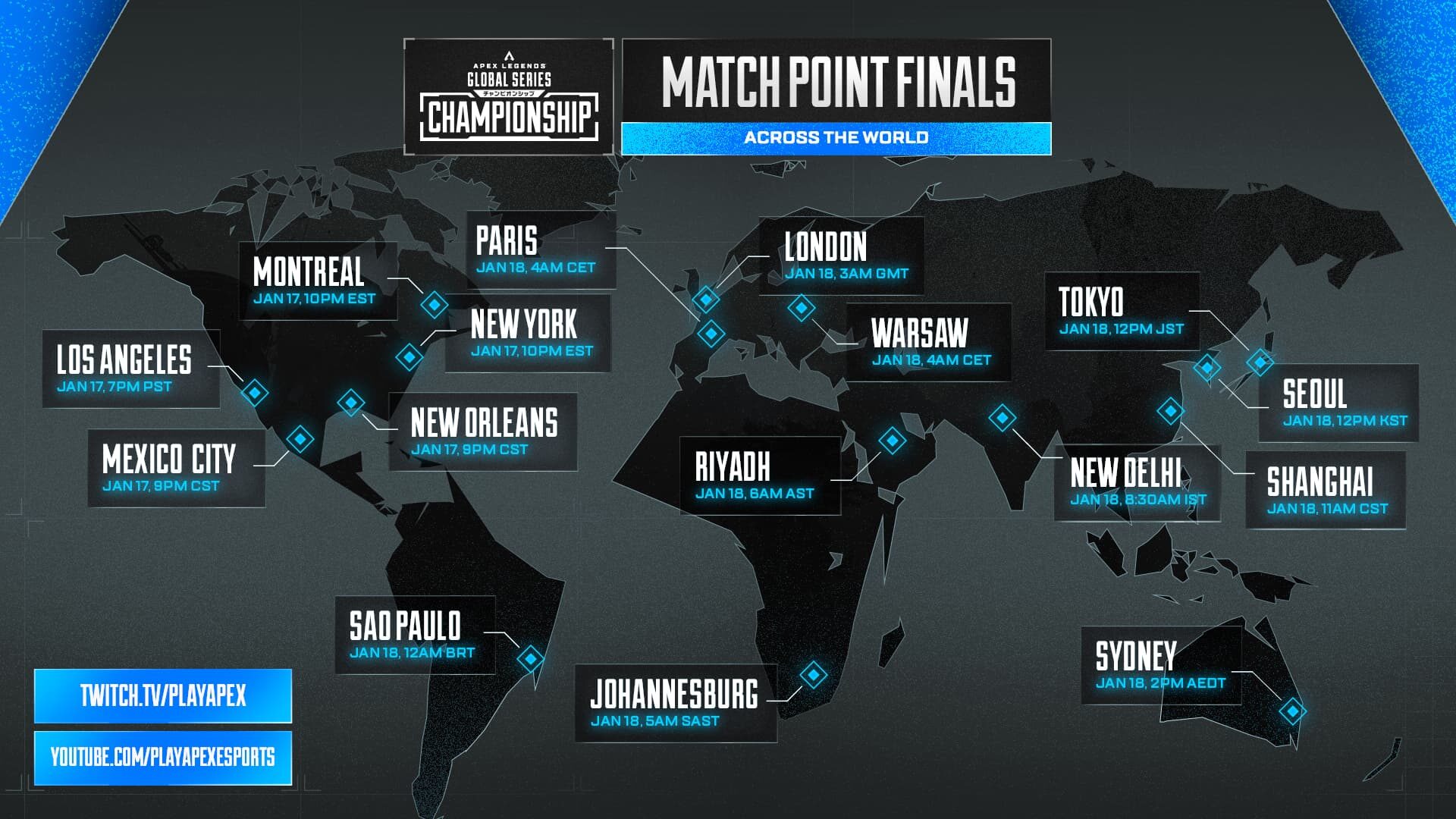
The most unique—and heart-pending—aspect of Apex Legends is the Match Point Format used during Finals. In a standard tournament, the team with the most points after a set number of games wins. In the ALGS, the finish line is much harder to cross.
To be crowned the champion, a team must cross two distinct hurdles:
- The Threshold: A team must first accumulate a specific number of points (historically 50 points) across multiple matches.
- The Checkmate: Once a team has crossed that 50-point mark, they are “Match Point Eligible.” However, they don’t win immediately. They must win a subsequent match (take 1st place) to end the tournament and claim the trophy.
This creates a “sudden death” atmosphere. If five teams are on Match Point, the very next game could be the last. Conversely, if no one on Match Point wins the game, the tournament continues, sometimes stretching into grueling 10-match marathons where players are physically and mentally exhausted. This format prevents “boring” victories where a team wins the tournament by playing safe; to be the champ, you have to seize the win under the ultimate pressure.
Why Every Point Tells a Story – ALGS Scoring System Guide

Understanding the scoring transforms the viewer from a spectator into a tactician. When you see a team in the bottom five of the standings suddenly “send it” on a risky push, you realize they aren’t playing recklessly—they are hunting for the kill points necessary to leapfrog the competition before the next match.
The financial stakes add even more weight to these numbers. With a $125,000 USD prize pool per region for Split 1, every single kill and every placement jump can represent thousands of dollars in difference for the organizations involved. By the time we reached the mid-season 26 patch in October, the way teams valued these points shifted even further as Legend balances changed, but the core math remained the same: stay alive, and keep shooting.


